⚡ Brilliant Global Competition · 2026–2027
Build a smart city.
Block by block.
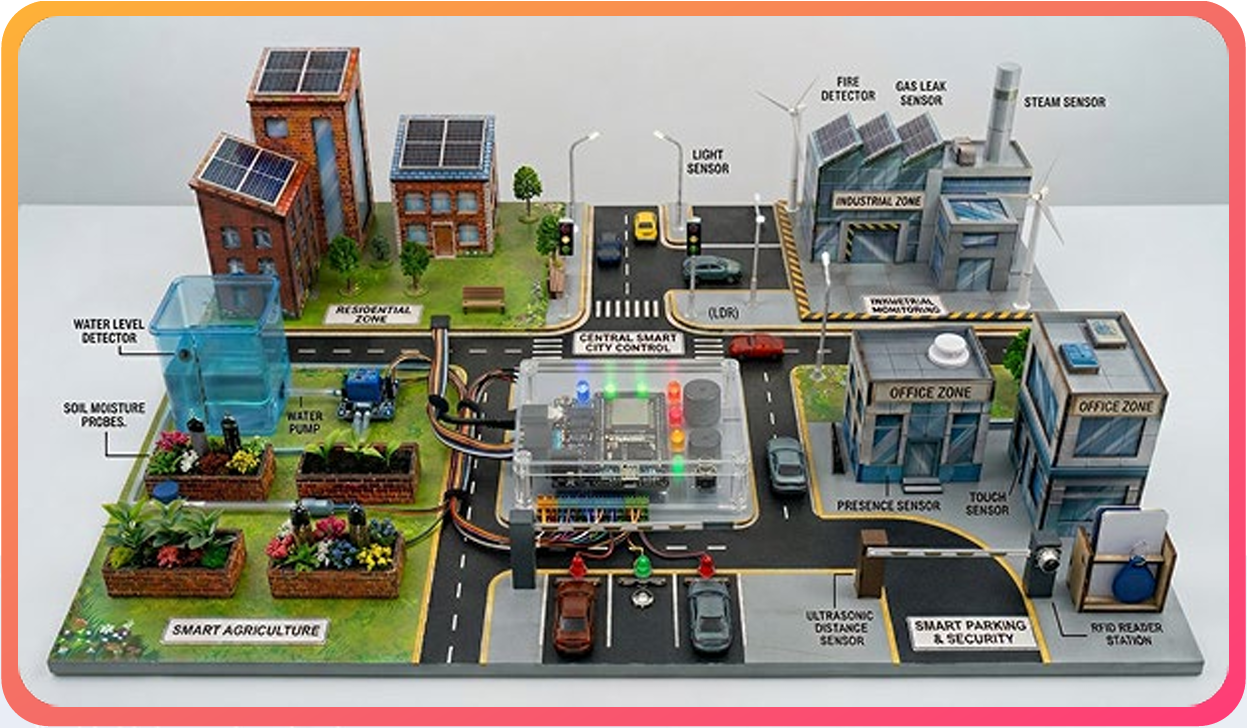
Drag-and-drop programming, real ESP32 hardware, and a path from your school's regional championship to the BGC Global Championship in Washington, D.C. You'll build four working smart-city projects, then bring them to life as a model.
Why you're here
This tutorial is the technology companion for the Brilliant Global Competitions, global STEM competitions where students apply technology, engineering, science, mathematics, and creative design to solve real-world challenges. The 2026–2027 theme is Smart Cities: Where Smart Vision Meets IoT-Driven Reality.
Students design and build a fully-functional Smart City model using real Internet of Things (IoT) sensors. National and Regional Champions compete at the Global Championship in Washington, D.C., with a Global Champion experience that includes a 3-day NASA workshop and visits to MIT and Harvard.
Your STEM teacher guides the urban-design and presentation pillars; these pages cover the tech half: the hardware in your kit, the block-based programming, and the projects themselves.
How the tutorial is organised
-
Part 1 · Getting Started
What is IoT? What's in your kit? Install the software, learn how blocks work, and write your first program.
-
Part 2 · Smart Agriculture
Self-watering plant. Soil moisture, water level, pump.
-
Part 3 · Smart Parking
Spot detection + automated RFID gate.
-
Part 4 · Smart Safety
Fire and gas-leak detection with audible alarm.
-
Part 5 · Smart Temperature
Automatic fan control + live temperature display.
The four smart-city pillars
Each project maps to one of the four pillars that define real smart cities:
| Pillar | What it covers | Your project |
|---|---|---|
| 🌿 Sustainability: Smart Irrigation & Water Management | Water supply, irrigation, efficiency | Smart Agriculture |
| 🚦 Mobility: Smart Mobility & Traffic Systems | Roads, parking, transit, gates | Smart Parking |
| 🚨 Protection: Public Safety & Emergency Systems | Fire, gas, alarms, emergency response | Smart Safety |
| 🌡️ Comfort: Smart Environment & Climate Monitoring | Air quality, temperature, climate-aware buildings | Smart Temperature |
What you'll need
- Flowlence Code: free download, installed on your computer (Install guide)
- Brilliant Smart City Kit: ESP32 Plus board + the workshop sensors and modules (Meet your kit)
- A computer: Windows 10 or later with a free USB port
How each Part is structured
Every project Part follows the same three-step pattern:
- Component lessons: meet each sensor or actuator one at a time, learn how it works and how to read or control it
- Build the system: combine the components into a complete smart-city subsystem
- Try the extensions: open-ended challenges to make the project your own (judges love these)
A word before you start
Take it step by step
When something doesn't behave the way you expect, slow down and look closer. Open the Serial Monitor, add a serial print block, and watch what your program is actually doing. That's how every engineer figures things out, and it's the most important skill you'll build.
Ready?